
When people hear the word Kundli, they often think about marriage, career, money, or future predictions. However, a birth chart represents much more than these individual areas. It provides a broader picture of different aspects of life through planets, zodiac signs, houses, and their relationships with one another.
A Kundli Analysis begins with understanding these different elements and how they interact. Among them, the twelve houses hold special importance because each house represents a particular area of human life.
From personality and family to relationships, profession, finances, spirituality, and personal growth, the twelve houses create the basic framework of a Janam Kundli.
Understanding what each house represents can make it easier to understand your own birth chart and the different influences that may appear in it.
What Are the 12 Houses in a Kundli?
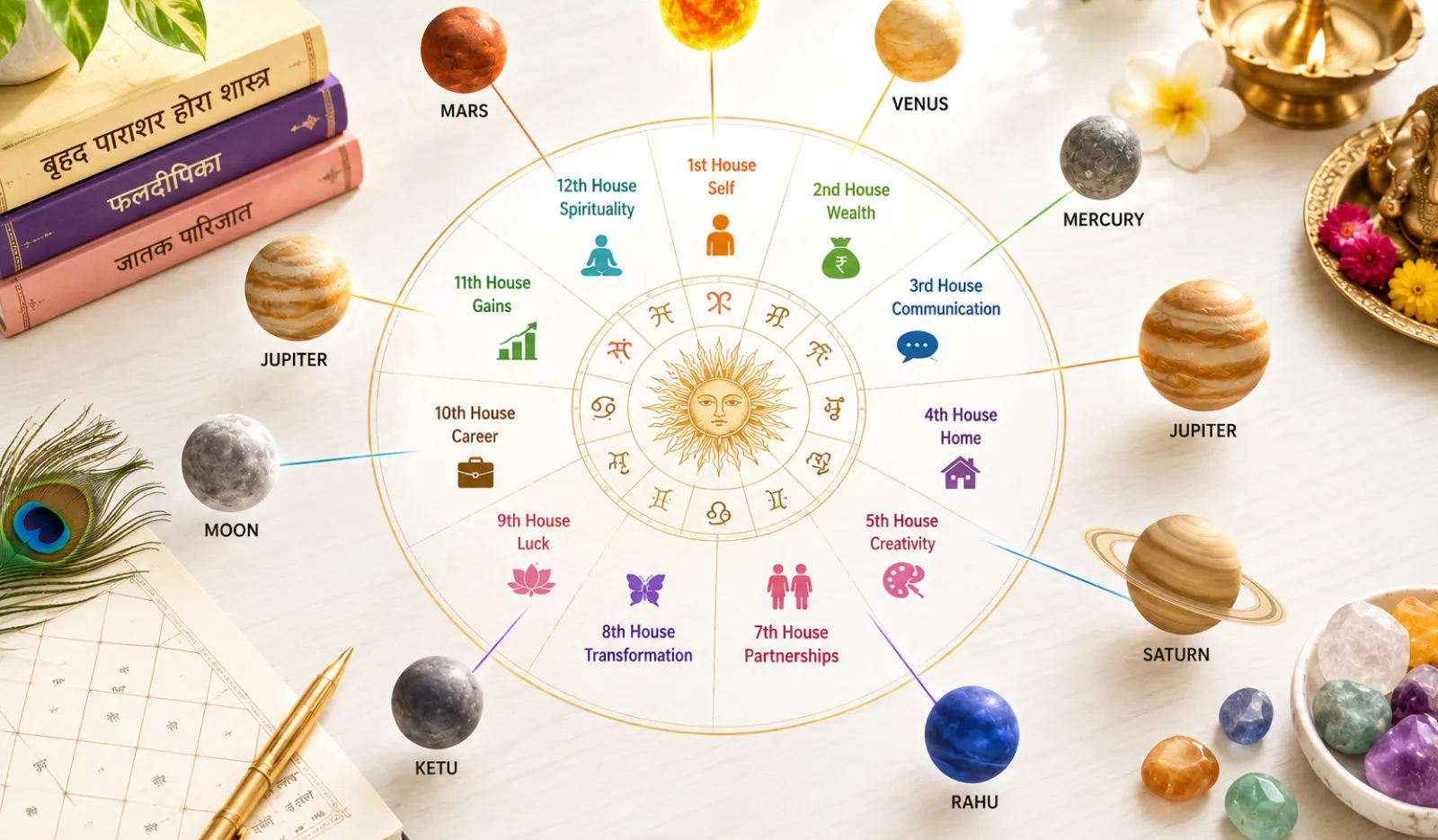
A Kundli is divided into twelve sections known as houses or Bhavas. Each house represents a particular area of life.
The first house begins with the Ascendant, commonly known as the Lagna. From there, the remaining eleven houses are counted in sequence.
For example, the seventh house is traditionally associated with marriage and partnerships, while the tenth house relates to career, profession, and public reputation.
However, an individual house should not normally be interpreted on its own. Planets occupying the house, the house lord, zodiac sign, planetary aspects, and other chart combinations can all influence its interpretation.
This is why a complete Kundli Reading looks at the birth chart as a connected system rather than focusing on one placement.
1st House: Self, Personality and Appearance
The first house is also known as the Ascendant or Lagna. It represents the individual and forms the starting point for understanding the rest of the chart.
This house is traditionally associated with personality, physical appearance, confidence, behaviour, individuality, and one's general approach to life.
It can provide insights into:
Personality and temperament
Physical appearance
Confidence
Behaviour and attitude
Individuality
General outlook toward life
The condition of the Ascendant and its ruling planet can therefore be important when studying someone's overall personality.
Because the first house establishes the starting point of the chart, it is one of the first areas astrologers examine during a birth-chart interpretation.
2nd House: Wealth, Family and Speech
The second house is associated with accumulated wealth, family, speech, food, possessions, and personal values.
When financial matters are being explored, this house can provide information about savings, accumulated resources, and attitudes toward material possessions.
It is also connected with family background and communication. The way a person speaks and expresses themselves may be considered through this house and its planetary influences.
The second house is commonly studied for:
Savings and accumulated wealth
Family environment
Speech and communication
Food habits
Possessions
Financial values
Financial interpretation, however, generally requires consideration of several houses rather than relying on this house alone.
3rd House: Courage, Communication and Efforts
The third house represents courage, initiative, communication, younger siblings, practical skills, short journeys, and personal effort.
Unlike areas associated with luck or sudden opportunities, this house is strongly connected with individual action and determination.
It can be relevant when exploring:
Communication abilities
Writing and creative expression
Courage
Practical skills
Younger siblings
Short-distance travel
Personal efforts
Someone with strong influences connected to this house may be interested in communication, media, writing, technology, or activities requiring initiative and consistent effort.
4th House: Home, Mother and Emotional Security
The fourth house represents home, family environment, mother, property, vehicles, education, emotional comfort, and inner peace.
It reflects the foundations of personal life and the environment where a person seeks security and comfort.
This house may be examined when exploring:
Home and domestic life
Relationship with mother
Property
Vehicles
Emotional stability
Inner peace
Certain aspects of education
The fourth house is not limited to physical surroundings. It can also represent one's sense of belonging and emotional foundation.
5th House: Love, Creativity, Education and Children
The fifth house is associated with creativity, intelligence, education, romance, children, hobbies, and self-expression.
It is often considered when examining love relationships and romantic interests. It can also represent creative abilities and intellectual interests.
The house may be relevant to:
Romantic relationships
Creativity
Intelligence
Education
Children
Hobbies
Self-expression
For relationship questions, astrologers may examine the fifth house together with the seventh house and other relevant factors.
Therefore, love-related interpretation is usually broader than simply looking at one planetary placement.
6th House: Work, Health, Competition and Challenges
The sixth house is traditionally connected with daily work, service, health routines, competition, debts, conflicts, and obstacles.
Although some of its themes can appear challenging, the house also represents discipline, persistence, and the ability to deal with everyday difficulties.
It may be considered when exploring:
Daily work
Service and responsibilities
Competition
Debts
Conflicts
Health-related tendencies
Ability to overcome challenges
The sixth house can therefore be understood not only through difficulties but also through the determination required to manage them.
7th House: Marriage and Partnerships
The seventh house is one of the most commonly discussed houses because of its connection with marriage, spouse, partnerships, and long-term relationships.
People interested in marriage predictions often want to know what their birth chart indicates about compatibility, partnership, and married life.
A detailed marriage interpretation may consider:
The seventh house
Seventh house lord
Venus
Jupiter
Planetary aspects
Relevant planetary combinations
Marriage-related astrology is therefore more complex than simply checking whether two zodiac signs are compatible.
When Kundli Analysis is performed for marriage, the overall chart and relevant relationship factors are considered together.
8th House: Transformation and Hidden Matters
The eighth house is associated with transformation, sudden changes, shared resources, inheritance, research, hidden matters, and deeper experiences.
It is sometimes misunderstood because of its association with unexpected changes. However, it does not necessarily represent only negative experiences.
The eighth house can also relate to:
Transformation
Research
Resilience
Shared finances
Inheritance
Hidden subjects
Major changes
Deeper understanding
Its themes often involve experiences that encourage a person to adapt, evolve, and understand aspects of life that may not be immediately visible.
9th House: Luck, Higher Learning and Spirituality
The ninth house is traditionally associated with fortune, higher education, spirituality, philosophy, long-distance travel, teachers, mentors, and personal beliefs.
It represents the search for knowledge and a broader understanding of life.
This house may be considered when exploring:
Higher education
Spiritual interests
Philosophy
Long-distance journeys
Teachers and mentors
Beliefs
Fortune and opportunities
In Vedic astrology, the ninth house can therefore have an important role when studying knowledge, guidance, and personal philosophy.
10th House: Career, Profession and Reputation
The tenth house is particularly important for career-related questions. It represents profession, responsibilities, achievements, authority, recognition, and public reputation.
People seeking career guidance through astrology may be interested in understanding this part of their birth chart.
The tenth house can be examined for themes such as:
Career direction
Profession
Leadership
Responsibilities
Achievements
Recognition
Public reputation
Career interpretation usually involves additional factors as well, including the second, sixth, and eleventh houses and their planetary influences.
A broader chart perspective can therefore provide more meaningful insight than focusing exclusively on the tenth house.
11th House: Income, Gains and Aspirations
The eleventh house represents gains, income, friendships, social networks, achievements, ambitions, and fulfilment of desires.
It can be particularly relevant when someone wants to understand financial gains or the results of professional efforts.
This house may provide insights into:
Income
Financial gains
Friendships
Social connections
Professional networks
Achievements
Aspirations
The eleventh house can also show how social relationships and networks may become connected with opportunities and personal goals.
12th House: Expenses, Foreign Connections and Spirituality
The twelfth house is the final house of the birth chart. It is traditionally associated with expenses, foreign places, isolation, sleep, spirituality, charity, and detachment.
It can become relevant for people interested in foreign travel, living abroad, spiritual development, or periods of solitude and introspection.
The twelfth house is associated with:
Expenses
Foreign connections
Foreign travel
Spirituality
Solitude
Charity
Detachment
Inner reflection
Rather than viewing the twelfth house only negatively, it can also be understood as representing release, introspection, and a movement away from excessive material attachment.
How Do Planets Influence the Houses?

Knowing the meaning of each house is only the beginning of understanding a birth chart.
The Sun, Moon, Mars, Mercury, Jupiter, Venus, Saturn, Rahu, and Ketu can influence different areas depending on their placement, zodiac sign, strength, aspects, and relationship with other planets.
For example, two people may have the same Ascendant but completely different planetary placements. As a result, their charts can have very different interpretations.
This is why a Janam Kundli should be examined as a complete chart rather than through one house or planet.
Importance of the Lagna Chart and Navamsa Chart
The Lagna Chart provides the basic structure used to understand the houses and planetary placements in a birth chart.
The Navamsa Chart is another important divisional chart used in Vedic astrology. It can provide additional information about planetary strength and is often considered when studying marriage and other deeper aspects of a chart.
These charts are generally interpreted alongside the main birth chart rather than separately.
Looking at multiple chart factors can provide a more detailed perspective than relying on one placement.
Mahadasha and Antardasha in Birth Chart Interpretation
Planetary periods are another important part of Vedic astrology.
Mahadasha and Antardasha are used to examine periods during which particular planetary influences become more prominent.
For someone interested in the timing of career developments, relationships, financial changes, or other major life themes, astrologers may consider these planetary periods along with the houses and planets involved.
This is often referred to as Dasha Analysis.
The timing system is not generally interpreted independently. It works alongside the planetary placements and other features of the birth chart.
What Is Considered in a Complete Birth Chart Reading?
A detailed interpretation may involve several different elements, including:
Ascendant or Lagna
Twelve houses
Planetary placements
Zodiac signs
House lords
Planetary aspects
Planetary strength
Divisional charts
Mahadasha and Antardasha
Important planetary combinations
These factors work together to create the overall picture of a birth chart.
For this reason, an online Kundli service that simply displays planetary positions may be useful for generating a chart, but understanding its meaning requires a broader interpretation.
Can a Kundli Predict Every Aspect of Life?
Astrology should not be viewed as a source of guaranteed outcomes. A birth chart is traditionally interpreted as a map of planetary influences and possible life themes.
Different areas can be explored through the relevant houses and planetary combinations, including relationships, career, finances, education, family, and spirituality.
The purpose of a detailed reading is to understand these patterns and possibilities rather than treating every interpretation as a fixed prediction.
Your choices, circumstances, efforts, and experiences also play an important role in how your life develops.
Why Understanding the 12 Houses Matters

The twelve houses provide a useful framework for understanding the different areas represented in a birth chart.
The first house relates to the self, the second to wealth and family, the seventh to marriage and partnerships, the tenth to profession, and the twelfth to expenses and spirituality. The remaining houses add their own dimensions to this overall picture.
When these houses are studied alongside planets, signs, house lords, and planetary periods, they can provide a much broader perspective.
This is the real purpose of Kundli Analysis - not simply to find one answer, but to understand how different parts of a birth chart connect with one another.
Final Thoughts
The twelve houses of a Kundli represent different dimensions of life. From personality and family to relationships, career, finances, challenges, achievements, and spirituality, each house contributes something different to the overall birth chart.
Understanding these houses is an excellent first step for anyone interested in Vedic astrology. However, their deeper meaning becomes clearer when they are studied together with planetary placements, zodiac signs, house lords, divisional charts, and planetary periods.
Whether you are exploring your career, relationships, financial goals, education, or personal development, your birth chart can offer an interesting astrological perspective on these areas.
At Astro Solution, you can explore your birth chart and seek personalised astrology guidance based on your individual Kundli and the questions that matter most to you.
Questions readers usually ask next.
1. What is Kundli Analysis?
Kundli Analysis is the study of a birth chart to understand planetary positions and their possible influence on areas such as personality, relationships, career, finances, family, and spirituality.
2. What do the 12 houses in a Kundli represent?
The 12 houses represent different areas of life. They cover subjects such as personality, wealth, family, communication, education, marriage, career, gains, spirituality, and personal growth.
3. Which house represents marriage in a Kundli?
The seventh house is traditionally associated with marriage, spouse, partnerships, and long-term relationships. Astrologers may also consider planets, the seventh house lord, and other relevant chart factors.
4. Which house is important for career in a birth chart?
The tenth house is primarily associated with career, profession, reputation, achievements, and responsibilities. Other houses, including the second, sixth, and eleventh, may also be considered for a broader career reading.
5. What is the difference between a Lagna Chart and a Navamsa Chart?
The Lagna Chart provides the main framework of the birth chart and its houses, while the Navamsa Chart is a divisional chart used to gain additional insights into planetary strength and certain areas of life.
6. Can a Kundli tell me about my future?
A birth chart is traditionally used to understand planetary influences, patterns, and possible life themes. It should not be considered a guarantee of specific future events, as personal choices and circumstances also matter.
Discussion
Discussion
Approved reader questions and editorial replies appear here after review.